The Indian economy grew a better-than-expected 7.6% during the second quarter of the fiscal, but analysts and economists were far from
happy. They expect the growth rate to slow over the next two quarters, and stressed on the need for further rate cuts to prevent a sharp slowdown.
Data released by the Central Statistical Organisation on Friday showed that all the eight economic sectors that contribute to the gross domes-tic product (GDP) recorded a lower growth year-on-year. The slow-down in the services sector — which accounts for nearly 60% of the output — was milder than expected, though.
Select industries such as trade, hotels, transport and communication saw better-than-expected growth, expanding 10.8% during the three months to September 30, almost on a par with year-ago levels. In-vestment during the period also remained robust, shoring up the GDP figure.
The economy expanded by 7.9% during the first quarter, taking the first-half GDP growth to 7.8 %. Economists had been expecting second quarter GDP to grow 6.9%, according to an ET poll of 12 analysts.
“The growth rate for the first half is healthy as the global economy is going through a slowdown. Growth in agriculture and allied services will pick up in the coming quarters,” finance minister P Chidambaram told reporters.
The PM’s economic advisory council expects GDP growth to be 7.7% this year, although other agencies are expecting it be be-low 7%, well short of the 9%-plus average growth of the past three years. Suresh Tendulkar, chairman of the PM’s economic advisory council, told ET that “agriculture and the manufacturing sector are expected to fare better in the coming quarters”.
He, however, said that the terror attacks in Mumbai, in which top five-star hotels were targeted and many foreign nationals were killed, would sour the overall investment sentiment.
Growth in manufacturing during the second quarter almost halved year-on-year to 5%, and was down 60 basis points compared with the preceding quarter. Growth in agriculture slipped to a two-year low of 2.7%, raising concerns about its potential impact on food inflation, which continues to rise despite falling headline inflation.
However, economists expect agriculture growth to rebound to 4% levels on the back of a spurt in output in the third quarter, benefiting from the good monsoon and expected interest rate cuts.
With the headline inflation no longer a major concern, some econo-mists said they expected the Reserve Bank of India (RBI) to cut its short-term repo rates by 50 to 100 basis points and signal a lower in-terest rate regime to boost the economy.
The inflation rate based on the wholesale price index fell to 8.84% during the week to November 15, and is well below the peak of nearly 13% witnessed in early August.
Finance minister P Chidambaram on Monday said GDP growth would be slower at 7-8% this year due to the ripple effects of the global fi-nancial crisis, but bounce back in the second quarter of the next fi-nancial year. The RBI is expecting a growth of 7.5% to 8% this year, while the Planning Commission expects GDP to grow at 7%.
Saturday, November 29, 2008


Saturday, November 22, 2008
Top Performing mutual funds
| Top Performers (12-Aug-2007 - 13-Aug-2008) | |
| For Complete Rankings, Click here | |
| Scheme | 1 Year Return (%) |
| Balanced | |
| Benchmark Split Capital Fund - Balanced - Class-B | 22.32 |
| ICICI Pru Blended - Plan B (G) | 8.40 |
| ICICI Pru Blended - Plan B (D) | 8.40 |
| Bond Funds | |
| Canara Robeco Income (Bonus) | 22.39 |
| Canara Robeco Income (Income) | 21.83 |
| Canara Robeco Income (Growth) | 21.62 |
| Equity - Diversified | |
| ICICI Pru Equity & Deriv -Income Optimis -Inst(D) | 14.98 |
| ICICI Pru Equity & Deriv -Income Optimis (D) | 13.83 |
| UTI-SPrEAD Fund (G) | 9.59 |
| Gilt Funds | |
| ICICI Pru Gilt Fund - Invest - PF Option | 26.38 |
| Canara Robeco Gilt (PGS)-(I) | 22.40 |
| Canara Robeco Gilt (PGS)-(G) | 22.32 |
| Index | |
| UTI-Gold Exchange Traded Fund (G) | 19.85 |
| Gold BeES | 19.78 |
| Kotak GOLD ETF | 19.74 |
| Liquid Funds | |
| Reliance Liquidity Fund (Div-M) | 22.24 |
| IDFC Liquid Fund (Div-M) | 14.67 |
| ICICI Pru Liquid (Div-Q) | 10.97 |
| Pension | |
| UTI-Retirement Benefit Pension Plan | -18.21 |
| UTI-Unit Linked Insurance Plan | -18.24 |
| Templeton India Pension Plan - (G) | -25.67 |
| Speciality (Sectoral Funds) | |
| Reliance Banking Fund - Inst (G) | 0.00 |
| Reliance Banking Fund - Inst (D) | 0.00 |
| Reliance Banking Fund - Inst (Bonus) | 0.00 |
| Tax Planning | |
| SBI Tax Advantage Fund - Series I (G) | 0.00 |
| SBI Tax Advantage Fund - Series I (D) | 0.00 |
| JM Tax Gain Fund (G) | 0.00 |
Sops for textile exporters shortly
Union Commerce Secretary G. K. Pillai on Friday said the textiles sector alone could lose five-lakh jobs in the next five months due to steep decline in exports. Stating that global economic slowdown had impacted the Indian export sector, Mr. Pillai said the Centre was working on a relief package for exporters.
Taking to journalists on the sidelines of a function here, Mr. Pillai said a survey had begun to assess how many jobs would be lost in the industry due to current crisis. A sample survey would be released by next week, containing data of about 800 companies.
Mr. Pillai also informed that a high-power committee, set up to examine the impact of global financial crisis on the Indian economy, will submit its recommendations by the end of next week, which would be followed by a relief package. A high-power committee, headed by Prime Minister Manmohan Singh with Finance Minister, Commerce and Industry Minister and Planning Commission Deputy Chairman its members, has been set up to handle the impact of global crisis on India and recommend various measures to bailout the industry, especially exporters that had been hit by the slowdown in Western markets.
Mr. Pillai said the impact of the global meltdown had been seen on the Indian economy in late September and October, adding that it would feel the impact of this financial crisis for at least next six months.
Exports in October this year stood at $12.8 billion against $14.6 billion in the corresponding period a year ago, a decline of 12.32 per cent.
By the end of December, the Government will review its export target of $200 billion for 2008-09, he added.
Friday, November 21, 2008
TRADING STOCK TRENDS
Why You Should Trade Trending Stocks
To consistently make money in the stock market, you only want trade stock trends! But what are the characteristics that make up a trend? I thought you would never ask.
Remember when we talked about stock market stages?
Well Stage 2 is an uptrend that is characterized by a series of higher highs (HH) and higher lows (HL).
Stage 4 is a downtrend that is characterized by a series of lower highs (LH) and lower lows (LL).
This creates a series of peaks and troughs on the chart that you can trade successfully.
Below is the the beautiful anatomy of stock trends:

Stocks Trends Vs. Trading Ranges
It is estimated that stocks only trend about 30% of the time. The rest of the time they move sideways in trading ranges. This is what a trading range looks like:

Yeah, trading ranges can get that sloppy! There is absolutely no reason to trade stocks that are chopping around like that when you can trade stocks that are in the trending phases. Trying to trade stocks in trading ranges (stage 1 and stage 3) is a great way to chew up your trading capital. Stick with trends! Here are some examples:

And now this one...

Which one would you rather trade? Case closed! I know all of this may seem pretty basic but I can’t tell you how many times I've been in a stock trading forum and Joe Trader says, “I bought XYZ stock yesterday at $32.57”.
So I go and look at the chart and the stock is in a steep downtrend! Or someone says that they shorted a stock at $52.03. So of course I look at the chart and the stock is in a parabolic uptrend!
Stage Analysis on a Stock Chart
To trade stocks successfully, you must first understand the four stock market stages that individual stocks and the overall market go through.
These cycles tell you if you should be long, short or in cash.
Once you are able to identify what stage it is in, you can then trade accordingly to those characteristics.
After a while you won’t even have to think about whether you should be long or short. You will know, without question, exactly what you should be doing NOW. You will either be focusing on long positions, short positions, or you will stay safely in cash - just by glancing at a chart!
Here are the four stages that stocks go through. This happens in all time frames whether it is a monthly chart, weekly chart, daily chart, or an intraday chart.

Ok, so I’m not the best artist in the world but I think it will serve our purpose here! What? You thought it would be more complicated that? My philosophy on the stock market is that if it is too complicated then it is just not worth doing. Now, we’ll look at the characteristics of the four stock market stages. I promise it will be painless!
Stage One
Stage 1 is the stage right after a prolonged downtrend. This stock has been going down but now it is starting to trade sideways forming a base. The sellers who once had the upper hand are now beginning to lose their power because of the buyers starting to get more aggressive. The stock just drifts sideways without a clear trend. Everyone hates this stock!
Stage Two
Finally stocks break out into Stage 2 and begins the uptrend. Oh, the glory of stage 2!! Sometimes I have dreams of stocks in Stage 2! This is where the majority of the money is made in the stock market. But here is the funny thing: No one believes the rally! That’s right, everyone still hates the stock. The fundamentals are bad, the outlook is negative, etc. But professional traders know better. They are accumulating shares and getting ready to dump it off to those getting in late. This sets up stage 3.
Stage Three
Finally, after the glorious advance of stage 2, the stock begins to trade sideways again and starts to "churn". Novice traders are just now getting in! This stage is very similar to stage 1. Buyers and sellers move into equilibrium again and the stock just drifts along. It is now ready to begin the next stage.
Stage Four
This is the dreaded downtrend for those that are long this stock. But, you know what the funny thing is? You guessed it. Nobody believes the downtrend! The fundamentals are probably still very good and everyone still loves this stock. They think the downtrend is just a “correction”. Wrong! They hold and hold and hold, hoping it will reverse back up again. They probably bought at the end of Stage 2 or during Stage 3. Sorry, you lose. Checkmate!
Here is an example:

Stock market stages occur in all time frames on every chart you look at. This could be a five minute chart of Microsoft or a weekly chart of the Dow.
Generally, you want to stay in cash when a stock (or the market itself) is chopping around in a stage one. In stage two you will want to be aggressively focusing on long positions. In stage three you want to be in cash. In stage four you want to be aggressively focusing on short positions.
That’s all there is to it. I told you that trading with stock market stages would be painless!
10 Best Candlestick Patterns
There are many candlestick patterns but only a few are actually worth knowing. Here are 10 candlestick patterns worth looking for.
Remember that these patterns are only useful when you understand what is happening in each pattern.
They must be combined with other forms of technical analysis to really be useful.
The following patterns are divided into two parts: Bullish patterns and bearish patterns. These are reversal patterns that show up after a pullback (bullish patterns) or a rally (bearish patterns).
Bullish Candlestick Patterns

Engulfing: This is my all time favorite candlestick pattern. This pattern consists of two candles. The first day is a narrow range candle that closes down for the day. The sellers are still in control of the stock but because it is a narrow range candle and volatility is low, the sellers are not very aggressive. The second day is a wide range candle that “engulfs” the body of the first candle and closes near the top of the range. The buyers have overwhelmed the sellers (demand is greater than supply). Buyers are ready to take control of this stock!
Hammer: As discussed on the previous page, the stock opened, then at some point the sellers took control of the stock and pushed it lower. By the end of the day, the buyers won and had enough strength to close the stock at the top of the range. Hammers can develop after a cluster of stop loss orders are hit. That’s when professional traders come in to grab shares at a lower price.
Harami: When you see this pattern the first thing that comes to mind is that the momentum preceding it has stopped. On the first day you see a wide range candle that closes near the bottom of the range. The sellers are still in control of this stock. Then on the second day, there is only a narrow range candle that closes up for the day. Note: Do not confuse this pattern with the engulfing pattern. The candles are opposite!
Piercing: This is also a two-candle reversal pattern where on the first day you see a wide range candle that closes near the bottom of the range. The sellers are in control. On the second day you see a wide range candle that has to close at least halfway into the prior candle. Those that shorted the stock on first day are now sitting at a loss on the rally that happens on the second day. This can set up a powerful reversal.
Doji: The doji is probably the most popular candlestick pattern. The stock opens up and goes nowhere throughout the day and closes right at or near the opening price. Quite simply, it represents indecision and causes traders to question the current trend. This can often trigger reversals in the opposite direction.
Bearish Candlestick Patterns

You’ll notice that all of these bearish patterns are the opposite of the bullish patterns. These patterns come after a rally and signify a possible reversal just like the bullish patterns.
Ok, now it’s your turn! I’ll let you figure out what is happening in each of the patterns above to cause these to be considered bearish. Look at each candle and try to get into the minds of the traders involved in the candle.
Kickers
There is one more pattern worthy of mention. A "kicker" is sometimes referred to as the most powerful candlestick pattern of all.
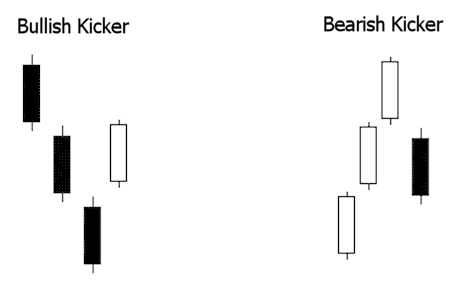
You can see in the above graphic why this pattern is so explosive. Like most candle patterns there is a bullish and bearish version. In the bullish version, the stock is moving down and the last red candle closes at the bottom of the range.
Then, on the next day, the stock gaps open above the previous days high and close. This "shock event" forces short sellers to cover and brings in new traders on the long side.
This is reversed in the bearish version.
Confirmation?
Most traders are taught to "wait for confirmation" with candlestick patterns. This means that they are supposed to wait until the following day to see if the stock reverses afterward. This is absolutely ridiculous!
I ain’t waitin’ for no stinkin’ confirmation!
How’s that for good grammar! Seriously, think about it for a second. If a stock pulls back to an area of demand (support) and I have a candlestick pattern that is telling me that buyers are taking control of the stock, then that is all the confirmation I need.
As a swing trader I have to get in before the crowd piles in, not when they get in! In other words, I want to be one of the traders that make up the pattern itself! That is the low risk, high odds play.
Just the way I like it.
Thursday, November 20, 2008
Oil firms to store crude on ships as oil tanks
Oil companies plan to store millions of barrels of crude at sea as they wait for demand to pick up and prices to rise.
So far oil companies have booked ships capable of holding up to 10 million barrels, brokers have said, more than the daily output of top exporter Saudi Arabia.
On Thursday U.S. oil trader Koch and Royal Dutch Shellwere the latest to confirm bookings of additional Very Large Crude Carriers (VLCC), brokers said.
The companies were not immediately available for comment.
Brokers said the cost of hiring vessels at current depressed rates would be less than the gains from waiting for an upturn in crude prices and in refiners' profit margins.
More oil and trading firms were also considering floating storage, they said.
"If you're looking at it from a cost perspective, just float the oil. The way to make money is to buy long and then go short," one trader said.
U.S. crude CLc1 has fallen more than $90 from its July peak above $147 a barrel as the slowing economy hurts global oil demand.
Some of the vessels were to load crude in the North Sea, the first time large volumes have been placed in floating storage there since the oil price crashed to below $10 a barrel in 1998.
"All this oil has to go somewhere, especially if the refiners aren't running at capacity," a Singapore-based crude oil trader said.
Koch has booked VLCC the Dubai Titan, with capacity to hold over two million barrels, for storage off the U.S. Gulf Coast. They added that Koch had already taken two other VLCCs for storage in the U.S. Gulf.
Oil major Shell has booked a second supertanker to store North Sea crude, ship brokers said.
They said Shell would use the Front Crown to load North Sea crude in the second week of December. The vessel will travel east to Indonesia's Karimun Islands, where oil is often transferred from supertankers to smaller vessels for delivery.
Shell booked another supertanker last week to take two million barrels from the North Sea for storage in the U.S. Gulf.
OPEC PRODUCERS
Although prompt delivery oil is very weak at around $50 a barrel on Thursday CLc1, its lowest level since January 2007. Contracts for March and April next year are above $53.
That has triggered some speculation big oil producers in the Organization of the Petroleum Exporting Countries could also store crude on ships for later sale.
But for Middle Eastern exporters, responsible for the bulk of any OPEC output cut, it is still cheaper to keep the oil in the ground.
"The only reason as a producer you would pay money to put crude in floating storage would be if you would otherwise struggle to get it out of the ground," said one Gulf industry source.
Goldman Cuts 2009 Oil Outlook, Closes Recommendations
Goldman Sachs Group Inc. cut its forecast for the average price of New York-traded crude oil in 2009 to $80 a barrel from $86, adding that it was closing all its trading recommendations for oil.
“Poor credit conditions and their negative implications for economic activity will continue to pressure WTI crude prices,” Goldman analysts led by Jeffrey Currie said in a report dated yesterday. “Over the past week, macroeconomic data confirmed the severity of recent economic weakness, reinforcing the concerns flagged by extremely weak physical commodities markets.”
A price average of $50 a barrel for most of next year is possible if economic and industrial activity in Asia fails to stabilize, the weekly report said. With this latest revision the bank has cut its 2009 outlook 46 percent since September.
“Although the worst of the commodity demand weakness in OECD economies is likely already behind us, the outlook for non- OECD demand is more uncertain,” the report added. “We are closing all of our oil trading recommendations.”
The report closed four oil-related recommendations. These involved trading the price difference gasoline and crude, a three-way transaction using crude options, buying crude swap contracts for 2012, and trading the difference between 2008 and 2013 futures.
Demand Growth
This last recommendation was running a loss of $40.88 a barrel, according to the report.
The bank lowered its old demand growth forecast for next year to 100,000 barrels a day, from 300,000 barrels a day. It also cut estimates for supply expansion outside the Organization of Petroleum Exporting Countries by 50 percent to 200,000 barrels a day, because of slower production recovery in the Gulf of Mexico and Azerbaijan.
Until a Sept. 16 report, Goldman had projected an average of $148 a barrel for West Texas Intermediate crude next year, the highest at that time among 35 analyst estimates compiled by Bloomberg.
Goldman said its year-end target of $107 a barrel for 2009 was unchanged by the revision to the annual average outlook. The bank has a three-month price target of $59 a barrel, six-month of $70 and 12-month of $102 a barrel.
“Poor credit conditions and their negative implications for economic activity will continue to pressure WTI crude prices,” Goldman analysts led by Jeffrey Currie said in a report dated yesterday. “Over the past week, macroeconomic data confirmed the severity of recent economic weakness, reinforcing the concerns flagged by extremely weak physical commodities markets.”
A price average of $50 a barrel for most of next year is possible if economic and industrial activity in Asia fails to stabilize, the weekly report said. With this latest revision the bank has cut its 2009 outlook 46 percent since September.
“Although the worst of the commodity demand weakness in OECD economies is likely already behind us, the outlook for non- OECD demand is more uncertain,” the report added. “We are closing all of our oil trading recommendations.”
The report closed four oil-related recommendations. These involved trading the price difference gasoline and crude, a three-way transaction using crude options, buying crude swap contracts for 2012, and trading the difference between 2008 and 2013 futures.
Demand Growth
This last recommendation was running a loss of $40.88 a barrel, according to the report.
The bank lowered its old demand growth forecast for next year to 100,000 barrels a day, from 300,000 barrels a day. It also cut estimates for supply expansion outside the Organization of Petroleum Exporting Countries by 50 percent to 200,000 barrels a day, because of slower production recovery in the Gulf of Mexico and Azerbaijan.
Until a Sept. 16 report, Goldman had projected an average of $148 a barrel for West Texas Intermediate crude next year, the highest at that time among 35 analyst estimates compiled by Bloomberg.
Goldman said its year-end target of $107 a barrel for 2009 was unchanged by the revision to the annual average outlook. The bank has a three-month price target of $59 a barrel, six-month of $70 and 12-month of $102 a barrel.
First batch of RIL's KG crude oil reaches HPCL
Hindustan Petroleum Corp Ltd has received the first consignment of crude oil from Reliance Industries' eastern offshore Krishna Godavari basin D6 block.
A ship carrying 59,000 tonnes of oil from the MA-1 field in predominantly gas-rich D6 block in the Krishna Godavari basin in the Bay of Bengal, reached HPCL's Vizag refinery in Andhra Pradesh yesterday evening, top company officials said.
Reliance sold the first consignment at USD 5.34 a barrel discount to Nigerian crude grade Bonny Light. Oil and Natural Gas Corp, India's largest crude oil producer, also benchmarks its prime Mumbai High crude at this grade.
Crude oil from MA-1, where production started in September, was to reach Vizag on November 17 but bad weather obstructed transportation. The weather cleared on Wednesday and a vessel carrying MA-1 oil reached the refinery jetty by evening.
Reliance is currently producing 10,000 barrels of crude oil per day from the MA-1 field.
The official said HPCL will study the properties of the crude oil for appropriate benchmarking. Thereafter, Reliance may enter into one-year sale contracts.
Besides Vizag, Chennai Refinery is also keen on KG-D6 crude, which is likely to peak to 40,000 bpd (2 million tonnes a year) in the second calendar quarter of 2009.
In all likelihood, Reliance may split the volumes equally between the two.
Reliance is the operator with a 90 per cent stake in the 7,645 square km D6 block, off the Andhra coast. Niko Resources of Canada holds the remaining 10 per cent interest.
The official said crude oil from the MA-1 field is stored on a floating, production, storage and off-loading vessel (FPSO) at the well-head and once critical volumes are reached it is transfered to a ship for transportation to a refinery.
Reliance, which had budgeted USD 1.5 billion for developing the oil field, has till now spent USD 950 million and would invest the remainder in drilling and tying in four additional wells.
A ship carrying 59,000 tonnes of oil from the MA-1 field in predominantly gas-rich D6 block in the Krishna Godavari basin in the Bay of Bengal, reached HPCL's Vizag refinery in Andhra Pradesh yesterday evening, top company officials said.
Reliance sold the first consignment at USD 5.34 a barrel discount to Nigerian crude grade Bonny Light. Oil and Natural Gas Corp, India's largest crude oil producer, also benchmarks its prime Mumbai High crude at this grade.
Crude oil from MA-1, where production started in September, was to reach Vizag on November 17 but bad weather obstructed transportation. The weather cleared on Wednesday and a vessel carrying MA-1 oil reached the refinery jetty by evening.
Reliance is currently producing 10,000 barrels of crude oil per day from the MA-1 field.
The official said HPCL will study the properties of the crude oil for appropriate benchmarking. Thereafter, Reliance may enter into one-year sale contracts.
Besides Vizag, Chennai Refinery is also keen on KG-D6 crude, which is likely to peak to 40,000 bpd (2 million tonnes a year) in the second calendar quarter of 2009.
In all likelihood, Reliance may split the volumes equally between the two.
Reliance is the operator with a 90 per cent stake in the 7,645 square km D6 block, off the Andhra coast. Niko Resources of Canada holds the remaining 10 per cent interest.
The official said crude oil from the MA-1 field is stored on a floating, production, storage and off-loading vessel (FPSO) at the well-head and once critical volumes are reached it is transfered to a ship for transportation to a refinery.
Reliance, which had budgeted USD 1.5 billion for developing the oil field, has till now spent USD 950 million and would invest the remainder in drilling and tying in four additional wells.
Tata Steel to treble profit margins at Corus
World's sixth largest steel maker Tata Steel aims to treble profit margins at its European subsidiary Corus in over five years, notwithstanding the global economic downturn impacting the industry.
"Tata Steel is aiming to triple profit margins at Corus over five years...," the Financial Times reported on Wednesday.
Quoting Tata Steel Managing Director B Muthuraman, the daily said the target could be reached partly by improving manufacturing procedures at the Corus plants spread across Europe. The Indian conglomerate Tatas had acquired the Anglo-Dutch steel maker Corus for about USD 13 billion last year.
Under Muthuraman's plans, the report said, earnings before interest, tax, depreciation and amortisation for Tata Steel as a whole would rise to 30 per cent of sales by 2013, "up from what he is estimating will be about 14 per cent this year."
According to the Financial Times, currently, EBITDA margins in Tatas Jamshedpur plant are 36 per cent, compared with 7 per cent in Europe where the firm has 80 per cent of its worldwide output of an expected 26 million tonnes this year.
"He (Muthuraman) hopes the EBITDA margin in Europe will rise to 20-25 per cent," the report added.
The daily said that Muthuraman's calculations are based on the assumption that the price of standard steel is about USD 500 per tonne.
Till a few months ago, the rates were hovering as much as USD 1,250 a tonne.
Meanwhile, in view of slackening demand for the commodity from consuming sectors like automobile and construction, Corus recently announced cutting down production by 30 per cent till March next year.
Attributing to Muthuraman, the report said the problems for the industry were temporary.
"Certainly we have a difficult situation in Europe (in relation to steel demand). But one thing I know for sure: human civilisation cannot exist without steel," Muthuraman was quoted as saying.
The report also noted that Muthuraman has ruled out substantial job cuts at least in the short term for its European plants.
A few days back, however, Corus had said about 400 of its employees in distribution business would lose jobs due to the financial turmoil, which has led to a steep fall in demand.
Corus employees about 42,000 people across its plants in Europe. The distribution business employs about 2,600 people.
"Tata Steel is aiming to triple profit margins at Corus over five years...," the Financial Times reported on Wednesday.
Quoting Tata Steel Managing Director B Muthuraman, the daily said the target could be reached partly by improving manufacturing procedures at the Corus plants spread across Europe. The Indian conglomerate Tatas had acquired the Anglo-Dutch steel maker Corus for about USD 13 billion last year.
Under Muthuraman's plans, the report said, earnings before interest, tax, depreciation and amortisation for Tata Steel as a whole would rise to 30 per cent of sales by 2013, "up from what he is estimating will be about 14 per cent this year."
According to the Financial Times, currently, EBITDA margins in Tatas Jamshedpur plant are 36 per cent, compared with 7 per cent in Europe where the firm has 80 per cent of its worldwide output of an expected 26 million tonnes this year.
"He (Muthuraman) hopes the EBITDA margin in Europe will rise to 20-25 per cent," the report added.
The daily said that Muthuraman's calculations are based on the assumption that the price of standard steel is about USD 500 per tonne.
Till a few months ago, the rates were hovering as much as USD 1,250 a tonne.
Meanwhile, in view of slackening demand for the commodity from consuming sectors like automobile and construction, Corus recently announced cutting down production by 30 per cent till March next year.
Attributing to Muthuraman, the report said the problems for the industry were temporary.
"Certainly we have a difficult situation in Europe (in relation to steel demand). But one thing I know for sure: human civilisation cannot exist without steel," Muthuraman was quoted as saying.
The report also noted that Muthuraman has ruled out substantial job cuts at least in the short term for its European plants.
A few days back, however, Corus had said about 400 of its employees in distribution business would lose jobs due to the financial turmoil, which has led to a steep fall in demand.
Corus employees about 42,000 people across its plants in Europe. The distribution business employs about 2,600 people.
Inflation eases to 8.90%; may prompt RBI to infuse cash
Inflation has further declined to 8.90 per cent for the week ended November 8 from 8.98 per cent a week ago, a development that may prompt the Reserve Bank to inject more liquidity into the system to overcome the cash crunch.
The inflation, measured by movement in wholesale prices, has come down by 0.08 percentage points mainly on account of declining prices of fuel items, triggered by fall in international crude prices.
While the prices of light diesel oil (LDO) dipped sharply by 11 per cent during the week, in case of furnace oil and aviation fuel they came down by nine per cent and five per cent, respectively.
The inflation rate was 3.20 per cent a year ago.
The index of fuel, power, light and lubricants declined by 0.9 percentage points during the week under review.
Prices of naphtha, which is an important industrial fuel, were down by four per cent.
The prices of crude in the international market came down to USD 52.82 per barrel, down from a high of about USD 147 a barrel in July.
In the primary articles category, the prices of jowar, tea and maize too came down marginally during the week under review.
Food, fruits and vegetables, however, became dearer in the wholesale market. According to the inflation data, the fruits and vegetables prices were up by 0.3 per cent and 2.6 per cent, respectively, while food index rose by 0.01 per cent.
Some pulses such as masoor and arhar, too, became expensive during the week.
The inflation for the week ended September 13, 2008, was revised to 12.42 per cent from provisional estimate of 12.14 per cent.
RBI has, since October, reduced the mandatory deposit that banks keep with the central bank (Cash Reserve Ratio) by 350 basis points to 5.5 per cent, the deposit that banks park in government securities (Statutory Liquidity Ratio) by 100 basis points and short-term (repo) lending rates by 150 basis points to signal softer interest rate regime.
Over all RBI has unlocked about Rs 2,75,000 crore of banking funds to ease the liquidity crunch.
The industry chambers as well as the banks have also been pitching for more measures to ease the cash-strapped system, which has started hitting the real economy, especially the real estate and automobile sectors.
The inflation, measured by movement in wholesale prices, has come down by 0.08 percentage points mainly on account of declining prices of fuel items, triggered by fall in international crude prices.
While the prices of light diesel oil (LDO) dipped sharply by 11 per cent during the week, in case of furnace oil and aviation fuel they came down by nine per cent and five per cent, respectively.
The inflation rate was 3.20 per cent a year ago.
The index of fuel, power, light and lubricants declined by 0.9 percentage points during the week under review.
Prices of naphtha, which is an important industrial fuel, were down by four per cent.
The prices of crude in the international market came down to USD 52.82 per barrel, down from a high of about USD 147 a barrel in July.
In the primary articles category, the prices of jowar, tea and maize too came down marginally during the week under review.
Food, fruits and vegetables, however, became dearer in the wholesale market. According to the inflation data, the fruits and vegetables prices were up by 0.3 per cent and 2.6 per cent, respectively, while food index rose by 0.01 per cent.
Some pulses such as masoor and arhar, too, became expensive during the week.
The inflation for the week ended September 13, 2008, was revised to 12.42 per cent from provisional estimate of 12.14 per cent.
RBI has, since October, reduced the mandatory deposit that banks keep with the central bank (Cash Reserve Ratio) by 350 basis points to 5.5 per cent, the deposit that banks park in government securities (Statutory Liquidity Ratio) by 100 basis points and short-term (repo) lending rates by 150 basis points to signal softer interest rate regime.
Over all RBI has unlocked about Rs 2,75,000 crore of banking funds to ease the liquidity crunch.
The industry chambers as well as the banks have also been pitching for more measures to ease the cash-strapped system, which has started hitting the real economy, especially the real estate and automobile sectors.
Car company expects exports to remain flat
India's largest car maker Maruti Suzuki India said on Thursday it expects exports to remain flat this year in view of the global meltdown.
"Consequent to the global economic slowdown, we expect exports to remain flat this year. It will be the same as last year level of 53,000 units," company's Chief Executive Officer (sales) Mayank Pareek said after unveiling the "A-Star" here.
"Last year, the export growth was 21 per cent. This year we expect it to be the same," he said.
"A-Star, Maruti's eighth vehicle launched in less than 40 months, reinforces its dominance in the A2 segment, where Maruti Suzuki holds a 61 per cent market share" Pareek said.
A-Star will contribute three fourth (150,000 units) of Maruti Suzuki's overall export target of 200,000 units by 2010-11, he said, adding that the firm plans to commence exports of A-Star in early 2009, to Europe.
"We are looking at domestic sales of 50,000 units this year", Pareek said.
A-Star is the first car from Maruti's stable to be fitted with the new KB series engine, the K10B, designed to meet the current and forthcoming environment norms in India as well as advanced markets of the Western world.
"A-Star is Euro V ready and a green car as 85 per cent of the car is recyclable. In addition, it is free from hazardous materials like lead, cadmium, mercury and chromium", he said.
The car, already launched in Delhi amd Mumbai, has received a "very positive response", Pareek said.
The price of A-Star which comes in three variants LXi, VXi and top-end ZXi is Rs 3,46,254, Rs 3,73,407 and 4,10,407 respectively.
"Consequent to the global economic slowdown, we expect exports to remain flat this year. It will be the same as last year level of 53,000 units," company's Chief Executive Officer (sales) Mayank Pareek said after unveiling the "A-Star" here.
"Last year, the export growth was 21 per cent. This year we expect it to be the same," he said.
"A-Star, Maruti's eighth vehicle launched in less than 40 months, reinforces its dominance in the A2 segment, where Maruti Suzuki holds a 61 per cent market share" Pareek said.
A-Star will contribute three fourth (150,000 units) of Maruti Suzuki's overall export target of 200,000 units by 2010-11, he said, adding that the firm plans to commence exports of A-Star in early 2009, to Europe.
"We are looking at domestic sales of 50,000 units this year", Pareek said.
A-Star is the first car from Maruti's stable to be fitted with the new KB series engine, the K10B, designed to meet the current and forthcoming environment norms in India as well as advanced markets of the Western world.
"A-Star is Euro V ready and a green car as 85 per cent of the car is recyclable. In addition, it is free from hazardous materials like lead, cadmium, mercury and chromium", he said.
The car, already launched in Delhi amd Mumbai, has received a "very positive response", Pareek said.
The price of A-Star which comes in three variants LXi, VXi and top-end ZXi is Rs 3,46,254, Rs 3,73,407 and 4,10,407 respectively.
Rupee hits record low of 50.55 a dollar in early trade
Extending its losses in sync with the equity markets, the rupee tumbled by 42 paise against the dollar to 50.44/45, after hitting a new record low of 50.55 in early trade, strained by unabated capital outflows amid renewed worries over the US economy.
The domestic currency at the Interbank Foreign Exchange (Forex) market recovered marginally to 50.44/45 a dollar from early record lows after the central bank intervened in favour of the Indian unit, dealers said.
The rupee today resumed weaker at 50.50/51 a dollar against its previous close of 50.02/03 despite low global crude oil prices.
Marketmen said sustained capital outflows from sliding equity markets weighed on the rupee sentiment.
They said a fall in global markets, following indications of protracted recession as the US Federal Reserve slashed its economic growth forecast for 2009, impacted the market sentiments.
Oil prices fell below USD 53 a barrel in Asian trade this morning, inducing oil refiners to accumulate dollars for their monthly import payments, dealers added.
The domestic currency at the Interbank Foreign Exchange (Forex) market recovered marginally to 50.44/45 a dollar from early record lows after the central bank intervened in favour of the Indian unit, dealers said.
The rupee today resumed weaker at 50.50/51 a dollar against its previous close of 50.02/03 despite low global crude oil prices.
Marketmen said sustained capital outflows from sliding equity markets weighed on the rupee sentiment.
They said a fall in global markets, following indications of protracted recession as the US Federal Reserve slashed its economic growth forecast for 2009, impacted the market sentiments.
Oil prices fell below USD 53 a barrel in Asian trade this morning, inducing oil refiners to accumulate dollars for their monthly import payments, dealers added.
Tuesday, November 18, 2008
Indian bond yields drop on rate cut expectations
Indian federal bond yields fell on Tuesday, shrugging off concerns over heavy government borrowing, after the finance minister said more steps would be taken to stimulate the economy.
Palaniappan Chidambaram also met the Reserve Bank of India (RBI) Governor Duvvuri Subbarao on Tuesday, bolstering expectations the monetary policy may be eased further. [ID:nBOM139236]
The benchmark 10-year bond yield ended at 7.46 percent, compared with Monday's close of 7.51 percent.
"There are strong expectations that the RBI may cut rates and this is helping sentiment," a dealer with a private sector bank said.
The 10-year yield initially rose to 7.64 percent as traders were wary of more government borrowing after Monday's announcement of a 90 billion rupees ($1.8 billion) bond auction on Friday.
The government's finances are strained due to increase in salaries of government employees, higher subsidies on fuel and fertilisers, waiver of farm loans as well as fall in tax revenues following a slowing economy.
The central bank will also sell 48.5 billion rupees of 10-year loans for state governments on Thursday.
The central bank has aggressively cut its rates over the past two months.
The repo rate has been cut by 150 basis points to 7.5 percent since October and the cash reserve ratio, the proportion of deposits that banks have to keep with the central bank, has been reduced by 350 basis points to 5.5 percent. ($1 = 49.7 rupees)
Yahoo Rises as Yang Exit Sparks Microsoft Speculation
Yahoo! Inc., owner of the second- largest U.S. Internet-search engine, rose as much as 17 percent in Nasdaq trading after Chief Executive Officer Jerry Yang agreed to step down, opening the door for a fresh Microsoft Corp. bid.
Yahoo, based in Sunnyvale, California, climbed $1.23 to $11.86 at 12:16 p.m. New York time in trading on the Nasdaq Stock Market. The gain was the largest in a month.
Before today, the company's market value had fallen by more than $20 billion since Yang took over last year as discussions with Microsoft failed, an ad partnership with Google Inc. collapsed and talks with Time Warner Inc.`s AOL stalled. Goldman Sachs Group Inc. said the resignation may fuel speculation of renewed talks with Microsoft or another suitor.
``The strategic necessity here is for this company to merge with Microsoft,'' Larry Haverty, a fund manager at Gamco Investors Inc. in Rye, New York, said in a Bloomberg Television interview. Gamco manages about $24 billion, including Yahoo shares. ``This is just unmitigated good news for the Yahoo shareholders.''
Microsoft and Yahoo trail Google, which controls more than 60 percent of the Internet-search market in the U.S. Microsoft has said that while it's open to a search-ad deal with Yahoo, it isn't interested in buying the company outright. Microsoft bid as much as $33 a share for Yahoo this year, and Yahoo now trades at less than a third of that value. Microsoft may end up paying between $15 and $18 for Yahoo, Haverty said.
CEO Candidates
Yahoo President Susan Decker is a candidate for Yang's job, said Brad Williams, a spokesman for Yahoo. Yang, 40, will stay on the board and remain CEO until Yahoo finds a replacement, Yahoo said yesterday. He took the top job at the 13-year-old Internet company in June 2007.
``He played one too many poker hands up there and got caught,'' said Pat Becker of Becker Capital Management in Portland, Oregon. His firm owns Microsoft shares but not Yahoo. ``Microsoft still believes that it needs scale'' in the online advertising business.
Microsoft spokesman Bill Cox declined to comment. The Redmond, Washington-based company will hold its annual meeting for shareholders tomorrow.
There isn't a timeframe on finding a replacement for Yang, Yahoo's Williams said. Yang had been in discussions with the board about seeking a replacement for ``some time.''
Chief Yahoo
After Yahoo finds a new CEO, Yang will return to the role of ``Chief Yahoo,'' a title shared with co-founder David Filo. Yang held that position, which involves overseeing corporate strategy, partnerships and recruiting, before former CEO Terry Semel departed last year.
Other potential CEO candidates include Jonathan Miller, the former chairman of AOL; Dan Rosensweig, once Yahoo's operations chief; and Meg Whitman the former chief of Internet auctioneer EBay Inc., UBS analyst Ben Schachter said in a report today.
Yahoo hired Heidrick & Struggles International Inc. to help find a new CEO. The task may not be an easy one, said Neil Sims, a managing director in the San Francisco office of Boyden, an executive search firm.
``Whoever would inherit that role would be taking a huge personal career risk because they're handed a company in crisis,'' Sims said. ``If you were going to rebuild a viable organization, that was the time in 2007 to recruit an accomplished executive.''
Google, based in Mountain View, California, abandoned an agreement to sell ads alongside Yahoo's search results this month after U.S. regulators threatened a lawsuit to block the partnership, saying it would give Google too much power.
Global Crisis
Yang's plan to reverse Yahoo's slowing sales growth and profit declines was hampered by the global economic crisis, which caused advertisers to cut back on Internet spending. Yahoo announced plans in October to cut at least 1,500 jobs and reduce the number of contractors as finance, travel, retail and automotive advertisers scaled back their spending.
Yang's departure ``may open the door for dialogue that might not be there otherwise,'' said Michael Cuggino, a portfolio manager at Pacific Heights Asset Management in San Francisco. ``It may allow for some new blood, some new energy for maximizing shareholder value.''
Yahoo, based in Sunnyvale, California, climbed $1.23 to $11.86 at 12:16 p.m. New York time in trading on the Nasdaq Stock Market. The gain was the largest in a month.
Before today, the company's market value had fallen by more than $20 billion since Yang took over last year as discussions with Microsoft failed, an ad partnership with Google Inc. collapsed and talks with Time Warner Inc.`s AOL stalled. Goldman Sachs Group Inc. said the resignation may fuel speculation of renewed talks with Microsoft or another suitor.
``The strategic necessity here is for this company to merge with Microsoft,'' Larry Haverty, a fund manager at Gamco Investors Inc. in Rye, New York, said in a Bloomberg Television interview. Gamco manages about $24 billion, including Yahoo shares. ``This is just unmitigated good news for the Yahoo shareholders.''
Microsoft and Yahoo trail Google, which controls more than 60 percent of the Internet-search market in the U.S. Microsoft has said that while it's open to a search-ad deal with Yahoo, it isn't interested in buying the company outright. Microsoft bid as much as $33 a share for Yahoo this year, and Yahoo now trades at less than a third of that value. Microsoft may end up paying between $15 and $18 for Yahoo, Haverty said.
CEO Candidates
Yahoo President Susan Decker is a candidate for Yang's job, said Brad Williams, a spokesman for Yahoo. Yang, 40, will stay on the board and remain CEO until Yahoo finds a replacement, Yahoo said yesterday. He took the top job at the 13-year-old Internet company in June 2007.
``He played one too many poker hands up there and got caught,'' said Pat Becker of Becker Capital Management in Portland, Oregon. His firm owns Microsoft shares but not Yahoo. ``Microsoft still believes that it needs scale'' in the online advertising business.
Microsoft spokesman Bill Cox declined to comment. The Redmond, Washington-based company will hold its annual meeting for shareholders tomorrow.
There isn't a timeframe on finding a replacement for Yang, Yahoo's Williams said. Yang had been in discussions with the board about seeking a replacement for ``some time.''
Chief Yahoo
After Yahoo finds a new CEO, Yang will return to the role of ``Chief Yahoo,'' a title shared with co-founder David Filo. Yang held that position, which involves overseeing corporate strategy, partnerships and recruiting, before former CEO Terry Semel departed last year.
Other potential CEO candidates include Jonathan Miller, the former chairman of AOL; Dan Rosensweig, once Yahoo's operations chief; and Meg Whitman the former chief of Internet auctioneer EBay Inc., UBS analyst Ben Schachter said in a report today.
Yahoo hired Heidrick & Struggles International Inc. to help find a new CEO. The task may not be an easy one, said Neil Sims, a managing director in the San Francisco office of Boyden, an executive search firm.
``Whoever would inherit that role would be taking a huge personal career risk because they're handed a company in crisis,'' Sims said. ``If you were going to rebuild a viable organization, that was the time in 2007 to recruit an accomplished executive.''
Google, based in Mountain View, California, abandoned an agreement to sell ads alongside Yahoo's search results this month after U.S. regulators threatened a lawsuit to block the partnership, saying it would give Google too much power.
Global Crisis
Yang's plan to reverse Yahoo's slowing sales growth and profit declines was hampered by the global economic crisis, which caused advertisers to cut back on Internet spending. Yahoo announced plans in October to cut at least 1,500 jobs and reduce the number of contractors as finance, travel, retail and automotive advertisers scaled back their spending.
Yang's departure ``may open the door for dialogue that might not be there otherwise,'' said Michael Cuggino, a portfolio manager at Pacific Heights Asset Management in San Francisco. ``It may allow for some new blood, some new energy for maximizing shareholder value.''
Dunlop stops production at Sahagunj
Pawan Ruia-controlled Dunlop India on Monday stopped its Sahagunj mother plant here, saying the global meltdown had affected operations of the ailing unit.
A company spokesman said there had been no retrenchment and the 1,172 workers continued to be on the company’s rolls although they would be paid a consolidated wage. The entire matter had been decided after discussions with the unions, the company said. The union representatives could not be contacted for their comments
While the Ambattur unit has been closed for long, the Sahagunj unit in Hooghly district was carrying on operations stabilising production, at about 40 tonnes against a capacity of 90 tonnes. The product-mix comprised OTR (off-the-road) tyres and truck tyres.
“The meltdown has affected Dunlop’s revival plans and the company would utilise this time to recast production and perhaps change the product-mix,” a company official said.
Group company Falcon Tyres, making two-wheeler tyres with its unit in Mysore, will carry on normal operations for now, sources said.
The management expects the resumption of the plant at an early date.
A company spokesman said there had been no retrenchment and the 1,172 workers continued to be on the company’s rolls although they would be paid a consolidated wage. The entire matter had been decided after discussions with the unions, the company said. The union representatives could not be contacted for their comments
While the Ambattur unit has been closed for long, the Sahagunj unit in Hooghly district was carrying on operations stabilising production, at about 40 tonnes against a capacity of 90 tonnes. The product-mix comprised OTR (off-the-road) tyres and truck tyres.
“The meltdown has affected Dunlop’s revival plans and the company would utilise this time to recast production and perhaps change the product-mix,” a company official said.
Group company Falcon Tyres, making two-wheeler tyres with its unit in Mysore, will carry on normal operations for now, sources said.
The management expects the resumption of the plant at an early date.
Sobha Developers hits 52-wk low on pledging 5.9% equity to Bank Sarasin
Sobha Developers shares hit a new 52-week low after the real estate developer pledged 4.3 million shares or about 5.9 percent of equity
to Bank Sarasin & Co, based in Switzerland.
The bank now holds 13.7 per cent in Sobha through pledged shares. According to media reports, Sobha Developers has pledged upto 24 per cent of equity in Bank Sarasin and Credit Suisse so far.
At 12:50 pm, the stock was down 1.97 per cent at Rs 89.65 after slipping to a 52-week low of Rs 87.15.
to Bank Sarasin & Co, based in Switzerland.
The bank now holds 13.7 per cent in Sobha through pledged shares. According to media reports, Sobha Developers has pledged upto 24 per cent of equity in Bank Sarasin and Credit Suisse so far.
At 12:50 pm, the stock was down 1.97 per cent at Rs 89.65 after slipping to a 52-week low of Rs 87.15.
Government slaps 5% import duty on iron and steel
The government on Tuesday slapped a 5% import duty on specified iron and
More Pictures
steel products and 20% duty on crude soyabean oil in a move aimed at safeguarding the interests of domestic industry.
While bringing cheer to the industry, the move is also expected to give a marginal relief to the government revenues as well. The government, which has cut indirect taxes to stimulate the economy in the budget and then later in the financial year including exempting crude oil from import duty has witnessed a downslide in its excise and customs duty collections. The collections declined by 5% in October, 2008.
The changes come into effect immediately, an official statement said adding that the refund based service tax exemtion scheme for exporters had also been simplified and the period to file refund claims extended to six months from present 60 days.
The decision to impose cutsoms duty on wide range of pig iron, semi-finished, flat and long category of products, comes in the backdrop of prices of these commodities declining in the international market in recent times. The import duty, however, falls short of industry expectations. They demanded a 15% duty on steel imports.
Domestic firms demanded protection against imports as steel prices dipped from a high level of Rs 45,000-50,000 per tonne to Rs 32,000-34,000 per tonne and there are apprehensions of cheaper imports from countries like China, Thailand and Ukraine that have built up huge inventories flooding India.
Similarly, 20% customs duty on soyabean oil has been imposed after intense lobbying by the soya processing industry, would lead to a marginal overall increase in the price table of vegetable oils in India. Most traders had already factored the duty into the prices they have been quoting over the last one week.
Even so, industry is hopeful it would improve margins of local soya processors, as well as give better price signals to farmers planning to sow rapeseed mustard and groundnut in the coming rabi season December onwards.
However, it is unlikely to have little impact on physical soyabean oil imports, which are negligible right now. Soya oil is anyway outpriced by palm oil, which remains the consumer's top choice. Currently, refined palm oil is selling in the wholesale markets at Rs 30/kg, while soya oil produced locally is available for Rs 41/kg.
At this price differential, palm oil is the consumer's favourite oil. This is one reason why processors were demanding a duty on palm oil so that it blunts competition for soya oil.
More Pictures
steel products and 20% duty on crude soyabean oil in a move aimed at safeguarding the interests of domestic industry.
While bringing cheer to the industry, the move is also expected to give a marginal relief to the government revenues as well. The government, which has cut indirect taxes to stimulate the economy in the budget and then later in the financial year including exempting crude oil from import duty has witnessed a downslide in its excise and customs duty collections. The collections declined by 5% in October, 2008.
The changes come into effect immediately, an official statement said adding that the refund based service tax exemtion scheme for exporters had also been simplified and the period to file refund claims extended to six months from present 60 days.
The decision to impose cutsoms duty on wide range of pig iron, semi-finished, flat and long category of products, comes in the backdrop of prices of these commodities declining in the international market in recent times. The import duty, however, falls short of industry expectations. They demanded a 15% duty on steel imports.
Domestic firms demanded protection against imports as steel prices dipped from a high level of Rs 45,000-50,000 per tonne to Rs 32,000-34,000 per tonne and there are apprehensions of cheaper imports from countries like China, Thailand and Ukraine that have built up huge inventories flooding India.
Similarly, 20% customs duty on soyabean oil has been imposed after intense lobbying by the soya processing industry, would lead to a marginal overall increase in the price table of vegetable oils in India. Most traders had already factored the duty into the prices they have been quoting over the last one week.
Even so, industry is hopeful it would improve margins of local soya processors, as well as give better price signals to farmers planning to sow rapeseed mustard and groundnut in the coming rabi season December onwards.
However, it is unlikely to have little impact on physical soyabean oil imports, which are negligible right now. Soya oil is anyway outpriced by palm oil, which remains the consumer's top choice. Currently, refined palm oil is selling in the wholesale markets at Rs 30/kg, while soya oil produced locally is available for Rs 41/kg.
At this price differential, palm oil is the consumer's favourite oil. This is one reason why processors were demanding a duty on palm oil so that it blunts competition for soya oil.
Monday, November 17, 2008
China's Oil Demand Contracts `Sharply' on Bank Crisis
China National Petroleum Corp., the nation's biggest oil producer, said fuel demand has contracted ``sharply'' since September because of the global credit crisis.
``As the impact of the financial crisis on China's economy deepens, the company's operations have also been affected adversely,'' the Beijing-based parent of PetroChina Co. said in a statement on its Web site on Nov. 15. Stockpiles of crude oil and oil products have risen ``significantly,'' it said.
China, whose economy expanded at a slower pace for the fifth straight quarter between July and September, risks a ``drastic decline,'' the Finance Ministry said on Nov. 13. The nation's fuel demand growth may ease to an average 4 percent in the next two to three months, Gong Jinshuang, an engineer at China National's research unit, said in October.
China Petroleum & Chemical Corp., Asia's biggest oil refiner, will reduce crude processing by 10 percent in November from July's record as the nation's economic slowdown cuts fuel demand, company officials, who declined to be named because of internal rules, said last week.
The country's processing volume reached a record 30.3 million tons in July and fell to 29.8 million in October, according to customs data.
China will invest the equivalent of almost a fifth of its 2007 gross domestic product by the end of 2010 to spur growth in the fourth-largest economy as the world heads toward a recession, the State Council, or Cabinet, said on Nov. 9.
The 4 trillion yuan ($586 billion) economic stimulus package will provide ``enormous'' market opportunities for petrochemicals products, China Petrochemical Corp., parent of China Petroleum, said in its in-house newsletter today.
``As some overseas energy companies are keen to sell assets because of the banking crisis, domestic companies including China Petrochemical may benefit from potential takeovers,'' the company said.
``As the impact of the financial crisis on China's economy deepens, the company's operations have also been affected adversely,'' the Beijing-based parent of PetroChina Co. said in a statement on its Web site on Nov. 15. Stockpiles of crude oil and oil products have risen ``significantly,'' it said.
China, whose economy expanded at a slower pace for the fifth straight quarter between July and September, risks a ``drastic decline,'' the Finance Ministry said on Nov. 13. The nation's fuel demand growth may ease to an average 4 percent in the next two to three months, Gong Jinshuang, an engineer at China National's research unit, said in October.
China Petroleum & Chemical Corp., Asia's biggest oil refiner, will reduce crude processing by 10 percent in November from July's record as the nation's economic slowdown cuts fuel demand, company officials, who declined to be named because of internal rules, said last week.
The country's processing volume reached a record 30.3 million tons in July and fell to 29.8 million in October, according to customs data.
China will invest the equivalent of almost a fifth of its 2007 gross domestic product by the end of 2010 to spur growth in the fourth-largest economy as the world heads toward a recession, the State Council, or Cabinet, said on Nov. 9.
The 4 trillion yuan ($586 billion) economic stimulus package will provide ``enormous'' market opportunities for petrochemicals products, China Petrochemical Corp., parent of China Petroleum, said in its in-house newsletter today.
``As some overseas energy companies are keen to sell assets because of the banking crisis, domestic companies including China Petrochemical may benefit from potential takeovers,'' the company said.
Indian Markets Down on Japan Recession News
Stocks opened on a flat note with a positive bias on Monday tracking Asian peers.
National Stock Exchange’s benchmark Nifty rose 13.15 points or 0.38% to 2823. Bombay Stock Exchange’s 30-share Sensex climbed 34.70 points to 9420 from Friday’s close.
Japan contracted at an annual pace of 0.4% in the July-September period after a declining an annualized 3.7% in the second quarter. Falling business investment is behind the latest drop in economic output. Japan's government has been anticipating economic challenges, and is trying to negotiate parliamentary approval of a $300 billion stimulus package, its second this year.
Stocks across the region fell after two Asian economies – Japan and Hong Kong – slid into recession and the Group of 20 nations delayed agreeing on specific measures to combat the global crisis. However, the Nikkei average rose 1% in thin trade as some investors rushed in to buy following an initial sell-off after data showed Japan's economy was in recession.
US stocks also slid on Friday after a record drop in retail sales last month increased fears that American consumers' reluctance to spend will push the economy into an even deeper downturn than currently expected.
The Dow Jones Industrial Average slid 337.94 points, or 3.82%, to end at 8,497.31, Standard & Poor's 500 Index fell 38 points, or 4.17%, to finish at 873.29 and the Nasdaq Composite Index lost 79.85 points, or 5%, to close at 1,516.85.
National Stock Exchange’s benchmark Nifty rose 13.15 points or 0.38% to 2823. Bombay Stock Exchange’s 30-share Sensex climbed 34.70 points to 9420 from Friday’s close.
Japan contracted at an annual pace of 0.4% in the July-September period after a declining an annualized 3.7% in the second quarter. Falling business investment is behind the latest drop in economic output. Japan's government has been anticipating economic challenges, and is trying to negotiate parliamentary approval of a $300 billion stimulus package, its second this year.
Stocks across the region fell after two Asian economies – Japan and Hong Kong – slid into recession and the Group of 20 nations delayed agreeing on specific measures to combat the global crisis. However, the Nikkei average rose 1% in thin trade as some investors rushed in to buy following an initial sell-off after data showed Japan's economy was in recession.
US stocks also slid on Friday after a record drop in retail sales last month increased fears that American consumers' reluctance to spend will push the economy into an even deeper downturn than currently expected.
The Dow Jones Industrial Average slid 337.94 points, or 3.82%, to end at 8,497.31, Standard & Poor's 500 Index fell 38 points, or 4.17%, to finish at 873.29 and the Nasdaq Composite Index lost 79.85 points, or 5%, to close at 1,516.85.
Sunday, November 16, 2008
RBI stimulus for strapped credit market
A day after the G20 global leaders’ meet on tackling the financial crisis, the Reserve Bank of India took the lead among central banks in
moving to boost credit markets. The central bank removed the additional capital requirement placed on lending to real estate and provided an additional Rs 22,500 cr for cheap export refinance.
To boost dollar inflows, the RBI has allowed housing finance companies to borrow abroad and raised the ceiling on interest rates that banks could offer on non-resident deposits. The refinance facility aimed at encouraging banks to lend to mutual funds and finance companies has been extended to end March and corporates have been allowed to buy back foreign currency convertible bonds which are now quoting at dirt cheap rates.
A good part of the measures announced were demands by industry at their interaction at various levels with the government. In a statement issued here, the RBI said the higher risk weightage on real estate was introduced as a counter cyclical measure and was being rolled back keeping in mind the global macro economic situation. The measures come less than 24 hours after Federal Reserve chairman Ben Bernanke said that global policy makers would remain in close contact, monitor developments closely and stand ready to take additional steps.
According to measures announced on Saturday, banks can now offer Libor/swap rates plus 100 basis points on FCNR(B) rates as against the current ceiling of 25 basis points over Libor. Similarly, on NR(E)RA deposits the ceiling has been raised from Libor/swap rates plus 100 basis points to 175 basis.
For buy back of FCCBs, the RBI said it would consider proposals to prematurely buy back their FCCBs. The buy back should be financed by the company’s foreign currency resources held in India or abroad and/or out of fresh external commercial borrowing (ECB) raised in conformity with the current norms for ECBs. Proposals in this regard would be considered under the approval route. Extension of FCCBs would also be permitted at the current all-in cost for the relative maturity.
Given the likelihood of an export slowdown the RBI has decided to raise the eligible limit of export credit refinance for banks to 50% of the outstanding export credit eligible for refinance. This will provide additional liquidity support of around Rs 22,000 crore to the banks.
The rate of interest charged on the ECR facility will continue to be the prevailing repo rate under the LAF which is currently 7.5%. To ensure there is funding for employment intensive sectors, the RBI has decided to allocate to SIDBI and the NHB a sum of Rs 2,000 crore and Rs 1,000 crore, respectively.
moving to boost credit markets. The central bank removed the additional capital requirement placed on lending to real estate and provided an additional Rs 22,500 cr for cheap export refinance.
To boost dollar inflows, the RBI has allowed housing finance companies to borrow abroad and raised the ceiling on interest rates that banks could offer on non-resident deposits. The refinance facility aimed at encouraging banks to lend to mutual funds and finance companies has been extended to end March and corporates have been allowed to buy back foreign currency convertible bonds which are now quoting at dirt cheap rates.
A good part of the measures announced were demands by industry at their interaction at various levels with the government. In a statement issued here, the RBI said the higher risk weightage on real estate was introduced as a counter cyclical measure and was being rolled back keeping in mind the global macro economic situation. The measures come less than 24 hours after Federal Reserve chairman Ben Bernanke said that global policy makers would remain in close contact, monitor developments closely and stand ready to take additional steps.
According to measures announced on Saturday, banks can now offer Libor/swap rates plus 100 basis points on FCNR(B) rates as against the current ceiling of 25 basis points over Libor. Similarly, on NR(E)RA deposits the ceiling has been raised from Libor/swap rates plus 100 basis points to 175 basis.
For buy back of FCCBs, the RBI said it would consider proposals to prematurely buy back their FCCBs. The buy back should be financed by the company’s foreign currency resources held in India or abroad and/or out of fresh external commercial borrowing (ECB) raised in conformity with the current norms for ECBs. Proposals in this regard would be considered under the approval route. Extension of FCCBs would also be permitted at the current all-in cost for the relative maturity.
Given the likelihood of an export slowdown the RBI has decided to raise the eligible limit of export credit refinance for banks to 50% of the outstanding export credit eligible for refinance. This will provide additional liquidity support of around Rs 22,000 crore to the banks.
The rate of interest charged on the ECR facility will continue to be the prevailing repo rate under the LAF which is currently 7.5%. To ensure there is funding for employment intensive sectors, the RBI has decided to allocate to SIDBI and the NHB a sum of Rs 2,000 crore and Rs 1,000 crore, respectively.
Oil companies slash ATF prices
Amid falling international crude oil prices, state-run oil marketing companies (OMCs) on Saturday announced slashing of Aviation Turbine Fuel (ATF) prices by over 12 per cent, or Rs. 5,580 per kilolitre, in the first fortnight of the month.
However, there was little cheer for air travellers as airlines gave little indication of the passing on the benefit by reducing the prices of air tickets.
With this reduction, the ATF prices are now on a par with the levels that prevailed in September 2007.
The ATF price in Delhi was cut by Rs. 5,585.19 to Rs. 39,380.51 per kl with effect from midnight on Saturday, according to official sources. This is the fifth cut in ATF prices since August when the prices rose to an all-time high of Rs. 71,028.26 .
This is the third cut this month — the first was the monthly reduction, which was followed by a lowering of prices due to abolition of customs duty on the fuel.
Oil companies now fix rates every 15 days instead of the earlier practice of revising the prices based on the average oil price in the preceding month.
The ATF price in Mumbai will come down to Rs. 40,687.42 from Rs. 46,518.85 per kl.
The OMCs had reduced ATF prices to Rs. 48,656.59 on November 1 and then to Rs. 46,518.85 on November 4.
The airlines are maintaining they are studying the situation and will take a decision later.
The Finance Ministry recently abolished the 5 per cent import duty on ATF. The same day, Indian Oil Corporation, Bharat Petroleum Corporation Limited and Hindustan Petroleum Corporation Limited cut jet fuel prices in Delhi by Rs. 9,429.87 to Rs. 47,017.93 per kl, in line with the falling international oil prices.
Friday, November 14, 2008
OVL, partner strike more oil in Egypt
ONGC Videsh Ltd (OVL) and its partner IPR Red Sea Inc have made a second oil discovery in the North Ramadan Concession, Gulf of Suez, Egypt.
In a statement issued here, OVL, the overseas investment arm of ONGC said “The discovery in well North Ramadan-2 (NR-2) is the second oil discovery in this block.”
The discovery well is located on a separate fault block north of IPR’s first oil discovery, which produced approximately 3,000 bopd (barrels of oil per day) and 1.5 mmscfpd (million standard cubic feet per day) of gas during the testing phase.
According to the statement the tests of the second well reservoir produced up to 800 bopd of oil and 0.50 mmscfpd of gas.
Further analysis for development of the prospect is in progress, the statement said.
North Ramadan Concession Agreement was signed for petroleum exploration and exploitation in the Gulf of Suez, Egypt between the Arab Republic of Egypt and The Egyptian General Corporation as one part and consortium of OVL and IPR Red Sea Inc as the other part in 2005. The contract was effective from August 8, 2005.
OVL and IPR Red Sea Inc have 70 per cent and 30 per cent participating interest respectively in North Ramadan Concession.
ONGC Videsh and IPR are in the first phase of exploration in North Ramadan and have one remaining exploratory well to drill.
In a statement issued here, OVL, the overseas investment arm of ONGC said “The discovery in well North Ramadan-2 (NR-2) is the second oil discovery in this block.”
The discovery well is located on a separate fault block north of IPR’s first oil discovery, which produced approximately 3,000 bopd (barrels of oil per day) and 1.5 mmscfpd (million standard cubic feet per day) of gas during the testing phase.
According to the statement the tests of the second well reservoir produced up to 800 bopd of oil and 0.50 mmscfpd of gas.
Further analysis for development of the prospect is in progress, the statement said.
North Ramadan Concession Agreement was signed for petroleum exploration and exploitation in the Gulf of Suez, Egypt between the Arab Republic of Egypt and The Egyptian General Corporation as one part and consortium of OVL and IPR Red Sea Inc as the other part in 2005. The contract was effective from August 8, 2005.
OVL and IPR Red Sea Inc have 70 per cent and 30 per cent participating interest respectively in North Ramadan Concession.
ONGC Videsh and IPR are in the first phase of exploration in North Ramadan and have one remaining exploratory well to drill.
Stock Market FAQ's
| How do you measure inflation? |
Inflation is one of the biggest stories of recent weeks, and has received a great deal of attention from the media and politicians. At the same time, inflation is an economic problem that the average person meets on a daily basis in terms of higher prices, particularly of food products. How is inflation measured? In India, there are two broad measures of inflation - based on the consumer price index (CPI) and based on the wholesale price index (WPI). Of the two, the latter has a higher profile because it is measured every week. When you read about inflation rising to 7%, it is probably referring to inflation based on WPI. WPI is based on the wholesale prices of 435 items ranging from agricultural commodities like wheat, rice, groundnuts etc to manufactured products like steel, cement etc. A single index number is calculated based on those prices, and the inflation rate is calculated by comparing the most recent index number with that of a year ago. What is the government going to do about inflation? The government has taken some quick steps like trying to curb exports in sensitive commodities and reduce the cost of imports. The is done because exports reduce domestic supply adding to the pressure on prices . Therefore, the government has already banned the export of cement and non-basmati rice and may ban other commodity exports later. RBI has also taken action by raising rates, which will reduce liquidity and the total demand in the economy that will reduce the pressure on prices. |
| What are P-Notes? |
Participatory notes (P-Notes) are financial instruments used by hedge funds not registered with Sebi. How do P-Notes work? * India-based brokerages buy India-based securities and then issue P-Notes to foreign investors Why do FIIs use the Mauritius route? * India has a double taxation avoidance agreement (DTAA) with Mauritius |
| What is short selling? |
When an investor goes long on an investment, it means the stock has been bought believing its price will rise in the future. Conversely, when an investor goes short, he is anticipating a decline in share price. Short selling is the selling of a stock that the seller doesn't own. More specifically, short sale is the sale of a security that isn't owned by the seller, but that is promised to be delivered. When you short sell a stock, your broker will lend it to you. The stock will come from the brokerage's own inventory, from another one of the firm's customers, or from another brokerage firm. The shares are sold and the proceeds are credited to your account. Sooner or later, you must 'close' the short by buying back the same number of shares and returning them to your broker. If the price drops, you can buy back the stock at the lower price and make a profit on the difference. If the price of the stock rises, you have to buy it back at the higher price, and you lose money. Also, because you are being loaned the stock, you are buying on margin. In fact, you have to open a margin account to short stocks. |
| What are SWFs? |
A sovereign wealth fund (SWF) is a state-owned fund composed of financial assets such as stocks, bonds, property or other financial instruments. These are state savings which are invested for the purpose of investment returns. NATURE AND PURPOSE CONCERNS ON SWFs SWFs MOVES WORLDS LARGEST SOVEREIGN FUNDS DOES INDIA NEED AN SWF ? > FM says no proposal for Sovereign Fund for India |
| What is credit limit? |
The 'Credit limit' is the maximum amount you can spend or borrow using your Credit Card in one billing cycle. This limit is based on various factors relating to your income. The credit limit can be changed on the basis of your payment and transaction history. |
| How is the Sensex calculated? |
The Sensex , an abbreviation of the BSE sensitive index, is a market capitalisation-weighted index of 30 stocks representing a sample of large, well-established and financially sound companies. It is the oldest index in India and has acquired a unique place in the collective consciousness of investors. The index is widely used to measure the performance of the Indian stock markets. Sensex is considered to be the pulse of the Indian stock markets as it represents the underlying universe of listed stocks on The Stock Exchange, Mumbai. Further, as the oldest index of the Indian stock market, it provides time series data over a fairly long period of time (since 1978-79). Sensex is not only scientifically designed but also based on globally accepted construction and review methodology. Sensex Calculation Methodology As per the methodology, the level of index at any point of time reflects the free-float market value of 30 component stocks relative to a base period. The market capitalisation of a company is determined by multiplying the price of its stock by the number of shares issued by the company. This market capitalisation is further multiplied by the free-float factor to determine the free-float market capitalisation. The base period of Sensex is 1978-79, and the base value is 100 points. This is often indicated by the notation 1978-79=100. The calculation of Sensex involves dividing the free-float market capitalisation of 30 companies in the index by a number called the Index Divisor. The Divisor is the only link to the original base period value of the Sensex. It keeps the index comparable over time and is the adjustment point for all index adjustments arising out of corporate actions, replacement of scrips etc. During market hours, prices of the index scrips, at which latest trades are executed, are used by the trading system to calculate the Sensex every 15 seconds and disseminated in real time. Understanding Free-float Methodology Concept: Free-float Methodology refers to an index construction methodology that takes into consideration only the free-float market capitalisation of a company for the purpose of index calculation and assigning weight to stocks in the index. Free-float market capitalisation is defined as that proportion of total shares issued by the company that are readily available for trading in the market. It generally excludes promoters' holding, government holding, strategic holding and other locked-in shares that will not come to the market for trading in the normal course. In other words, the market capitalisation of each company in a free-float index is reduced to the extent of its readily available shares in the market. In India, BSE pioneered the concept of free-float by launching BSE TECk in July 2001 and BANKEX in June 2003. While BSE TECk Index is a TMT benchmark, BANKEX is positioned as a benchmark for the banking sector stocks.
Locked-in shares and shares which would not be sold in the open market in normal course. The remaining shareholders would fall under the free-float category. |
Subscribe to:
Posts (Atom)